Installation Guide
Unboxing
Unbox the UltimateSensor package. The box contains:
- UltimateSensor v2 in white or black, with LD2412 + LD2450 already installed
- SPS30 particulate matter sensor, pre-installed, if you ordered the version with SPS30
- A QR code on the inside of the box, which leads to this manual
A USB-C cable, power adapter and mount are not in the box. The USB-C adapter set (5 V adapter with a 3 m USB-C cable) and the Stand & Wall Mount are sold separately.
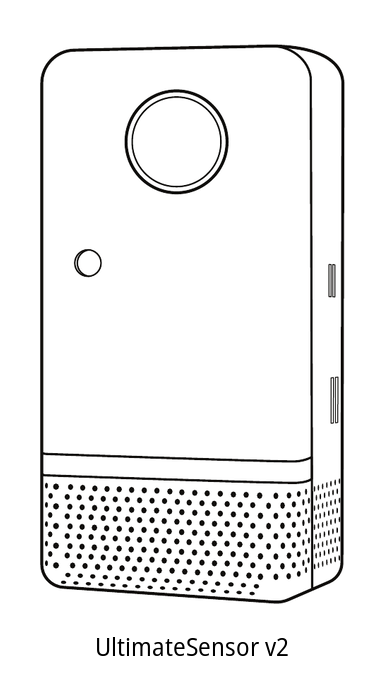
Optional LD2460 Upgrade
UltimateSensor v2 ships with LD2412 + LD2450 installed by default. Only replace the LD2450 if you have the optional LD2460 upgrade module and plan to flash the matching LD2460 firmware variant.
Disconnect power before opening the housing. Work slowly and avoid pulling on cables or sensor boards.
To replace LD2450 with LD2460:
- Place the UltimateSensor on a clean surface with the bottom side facing you.
- Find the small notch at the bottom of the housing.
- Use a small flat screwdriver to carefully click open the front of the housing.
- Remove the transparent plastic light guide in front of the LEDs.
- Carefully unclip the upper front cover plate.
- Remove the LD2450 module and replace it with the LD2460 module.
- Put the upper front cover plate back in place.
- Reinstall the transparent LED light guide.
- Carefully click the housing closed again in reverse order.
- Flash the matching LD2460 firmware.
After the upgrade, LD2460 replaces LD2450. Use the LD2460 target 1-5 X/Y/Distance/Angle entities and the shared Room Designer polygon zones instead of the LD2450-specific zone entities.
Before mounting and configuring Room Designer, follow the complete UltimateSensor v2 LD2460 Upgrade Guide. It explains physical orientation, wall height, angle, reporting recovery and detection range.
Optional: Add the SPS30 Later
If your UltimateSensor came without SPS30, you can add the SPS30 module yourself.
Disconnect power before opening the housing. Work slowly and avoid pulling on cables or sensor boards.
- Place the UltimateSensor on a clean surface with the bottom side facing you.
- Find the small notch at the bottom of the housing.
- Use a small flat screwdriver to carefully click the housing open.
- Take the circuit board out of the housing.
- Click the SPS30 into the back of the housing.
- Connect the SPS30 to the circuit board with the adapter cable from the SPS30 box.
- Put the circuit board back and carefully click the housing closed.
- Switch to the matching Complete firmware. The firmware page explains how.
Step 1: Power by Cable -OR- PoE
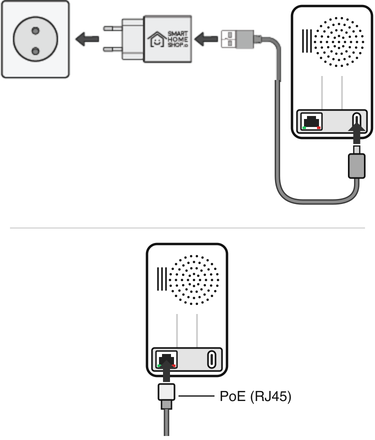
Connect the UltimateSensor to a USB-C power source: a 5 V adapter that provides at least 1 A. A cable and adapter are not in the box; the USB-C adapter set is sold separately.
After power-on the front LEDs breathe white and a short startup sound plays. You can turn this off with the Boot Sound & Animation switch.
Please note that powering the device by PoE or using an Ethernet connection instead of WiFi only works if the device has the Ethernet firmware installed. All UltimateSensor versions support PoE if the Ethernet firmware is installed. To switch between the firmware versions, please visit the Firmware page.
Step 2: Connect to WiFi
Upon starting up the UltimateSensor v2, it creates a WiFi hotspot named ultimatesensor (older firmware: ultimatesensor-v2). The password is the same as the name. Connect to this hotspot and a pop-up window will appear, allowing you to select and connect to your own WiFi network. Ensure that your WiFi network is a 2.4 GHz network. If the fallback hotspot does not appear, try using a different device. It may take up to one minute for the WiFi to become visible after powering on the device.

Note: When you connect to the fallback network, the web interface should open automatically. If that does not work, you can also navigate to http://192.168.4.1/ manually in your browser.
The setup page also lets you choose Home Assistant and/or the SmartHomeShop App, and the firmware variant.
You can also set up WiFi with Improv instead of the hotspot: over Bluetooth with Home Assistant on your phone, or over USB right after flashing with the web flasher.
Step 3: Connect to Home Assistant
Once connected to your home WiFi network, Home Assistant will automatically detect the UltimateSensor under the 'Devices & Services' section. If this does not happen, you need to add the device manually. Look up the IP address of the UltimateSensor in your router, then go to Home Assistant settings -> Devices & Services. Click on Add Integration, select ESPHome, and enter the IP address of the device. It will then be added.

After connecting to Home Assistant, your device will be visible under Home Assistant -> Settings -> Devices & Services -> look for the ESPHome integration. Click on it to see your UltimateSensor with all its entities.
Voice Assistant Setup
UltimateSensor v2 includes a built-in microphone, speaker and standard local wake word support. After the device is added to Home Assistant, configure a Home Assistant voice pipeline and select it on the UltimateSensor device page.
Use the full Voice Assistant Guide for wake word, TTS and media player setup.
Step 4: Configure Device Sensors
Note that all sensors need at least 10 minutes to start up, and the CO2 sensor may take up to 24 hours or several days. The sensors may also need calibration; please refer to the calibration guide for instructions.
Placement Recommendations
For best performance, follow these placement guidelines:
- Mount at a height of 1-2 meters (3-6 feet) from the floor for optimal sensor readings
- Place on a cabinet or mount on a wall
- Avoid direct sunlight to prevent inaccurate measurements and reduce risk of sensor damage
- Ensure good air circulation around the device
- For voice assistant use, avoid placing the device directly next to a TV, speaker, fan or other constant noise source
Read more in our usage guide
Stand & Wall Mount
The Stand & Wall Mount is sold separately. The set has a slide piece, a wall bracket and a freestanding foot.
- Slide the slide piece onto the UltimateSensor.
- For a wall, fix the wall bracket to the wall first. For a desk, shelf or cabinet, use the freestanding foot.
- Click the slide piece into the wall bracket or the foot.