Installation Guide
Step 1: Choose WiFi or Ethernet
Your WaterFlowKit ships with WiFi firmware pre-installed. If you want to use Ethernet or PoE, this is only available on WaterFlowKit V2 and you must run the Ethernet firmware variant.
| Connection | Supported on | What to do |
|---|---|---|
| WiFi | V1 and V2 | Continue with this installation guide and configure WiFi in Step 5 |
| Ethernet | V2 only | Flash/select WaterFlowKit V2 Ethernet before relying on the network cable |
| Ethernet Cloud | V2 only | Flash/select WaterFlowKit V2 Ethernet Cloud if you also use SmartHomeShop cloud sync |
| Thread | V2 only | Install the Thread firmware, see Connect via Thread |
Important: WiFi and Ethernet are different firmware variants. Plugging in an Ethernet cable is not enough if the device is still running WiFi firmware.
For the full switching guide, see WaterFlowKit V2 Ethernet & Network Configuration.
Unboxing
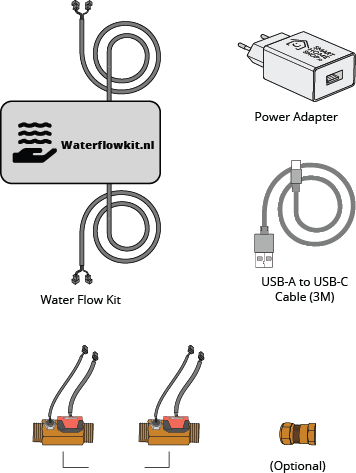
Unbox the WaterFlowKit package and identify all the components. You should have the following items:
- WaterFlowKit
- WaterFlow Sensor(s) with 1-meter cable and G1/2", G3/4", G1", G1½" or G2" connection (depending on which you ordered)
- USB-A to USB-C cable (3 meters) and power adapter, only if selected at checkout
Step 2: Install the Sensor(s)
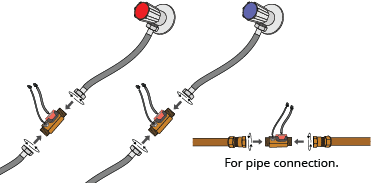
Install the waterflow sensor(s), ensure that all connections are securely tightened and properly waterproofed. Apply thread seal tape to the screw threads to guarantee a watertight seal. The temperature sensor requires extra tightening. It is crucial to double-check all fittings to prevent potential leaks.
Note: Please be aware that we are not responsible for any leakage that may occur.
Step 3: Connect Sensor(s) to Kit
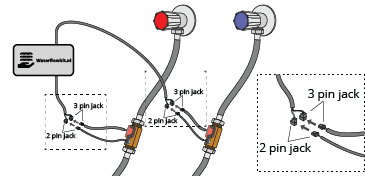
Connect the sensor(s) to the WaterFlowKit:
- The 3-pin jack is for the waterflow sensor.
- The 2-pin jack is for the temperature sensor (if applicable).
Step 4: Power by USB-C or PoE
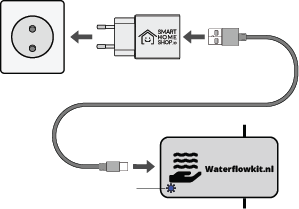
Connect the WaterFlowKit to a power source using a USB-C cable and power adapter (5V, 1A). On WaterFlowKit V2 with Ethernet firmware, you can also use PoE when your switch or injector supports it.
Using PoE? Make sure the device is running WaterFlowKit V2 Ethernet or WaterFlowKit V2 Ethernet Cloud firmware first. See Network Configuration.
Step 5: Connect to WiFi
Skip this step if you use Ethernet. For Ethernet setup and switching, see WaterFlowKit V2 Ethernet & Network Configuration.
Upon starting up with WiFi firmware, the WaterFlowKit emits a WiFi hotspot named waterflowkit with the password waterflowkit. Connect to this hotspot and the SmartHomeShop setup page opens. Pick your own WiFi network, enter the password and click Save and connect. On V2 you can also choose Ethernet here, see Network Configuration.
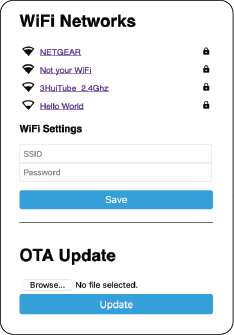
Note: When you connect to the fallback network, the web interface should open automatically. If that does not work, you can also navigate to http://192.168.4.1/ manually in your browser.
Step 6: Connect over Ethernet (V2 only)
If you use WaterFlowKit V2 with Ethernet firmware:
- Connect the Ethernet cable to the WaterFlowKit V2.
- Use a network with DHCP enabled.
- Keep Home Assistant on the same network or VLAN.
- If using PoE, verify that your PoE switch or injector powers the device.
- Wait until the device receives an IP address and appears in Home Assistant.
If you want to switch from WiFi firmware to Ethernet firmware after installation, use the Network Configuration guide.
Step 7: Connect to Home Assistant
Once connected to your network through WiFi or Ethernet, Home Assistant will automatically detect the WaterFlowKit under the 'Devices & Services' section.
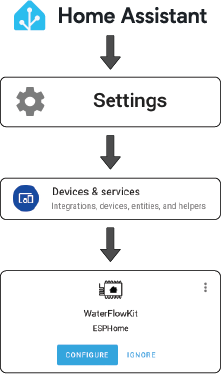
Select your sensor model: the firmware starts with YF-B1 / YF-B7 on every input. If you use a different sensor, set Flow1 Sensor Type to your model in Home Assistant, and do the same for the other inputs you use. Otherwise all flow and volume readings are wrong.
Note: If your setup does not include a temperature sensor, you will need to disable this entity in Home Assistant. Similarly, disable all entities of the inputs you do not use (V1 has 2 inputs, V2 has 4).
For calibration details and more comprehensive information, please refer to the usage section.
Quick Links
- WaterFlowKit V2 Ethernet & Network Configuration: WiFi, Ethernet, PoE and switching
- Firmware Guide: flashing via USB-C and firmware variants
- Usage Guide: calibration, dashboards and automations
- Troubleshooting: common issues and recovery